Since 1826, Shepherds Friendly has been helping people make informed financial decisions. As we celebrate our 200th year, we’ve once again run our annual Money Literacy study to explore just how financially confident Brits feel today and where gaps in their money knowledge remain.
We quizzed 2,000 people across the UK on their understanding of key personal finance topics, including ISAs, investing and financial planning. Alongside testing their knowledge, we asked how confident they feel navigating different areas of their finances.
The research also highlights some of the most common misconceptions around personal finance, revealing where people may be less knowledgeable than they think, as well as the areas where Brits feel least confident when making financial decisions.
Over two-fifths of Brits failed the 2026 money literacy test
Our 2026 results show that 56% of Brits passed the Money Literacy test, meaning that 44% failed to answer at least 60% of the questions correctly. This marks a notable improvement on 2025, when just 23% passed, and is also above the 27% pass rate recorded in 2023 and 49% in 2024.
While the 2026 results suggest that financial knowledge has improved compared with last year, more than two-fifths of Brits still failed to demonstrate a basic level of money literacy in this year’s test.
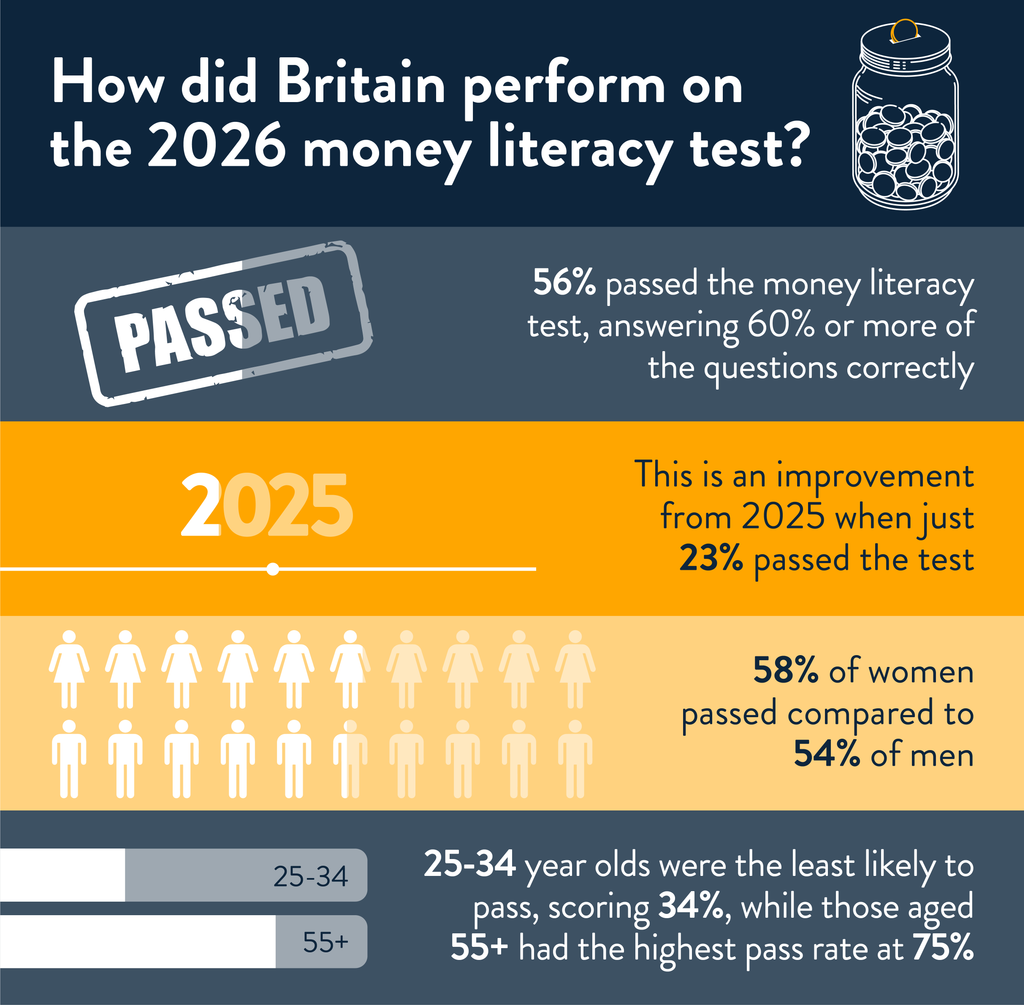
As we’ve seen in previous years, money literacy varies considerably by age. This year, 35% of 18-24-year-olds passed the quiz, a sharp rise from just 9% in 2025, while 75% of those aged 55 and over passed. Interestingly, 25-34-year-olds recorded the lowest pass rate of any age group, with just 34% passing the quiz.
The results show that, despite a substantial improvement among the youngest adults this year, a clear generational gap in financial knowledge remains.
| Age Group | Percentage That Passed | Percentage That Failed |
|---|---|---|
| 18-24 | 35% | 65% |
| 25-34 | 34% | 66% |
| 35-44 | 50% | 50% |
| 45-54 | 50% | 50% |
| 55+ | 75% | 25% |
Age isn’t the only factor at play, either. Looking at the results by gender, women were slightly more likely to pass the quiz than men this year, with 58% of women passing compared with 54% of men. This represents a shift from 2025, when 29% of men passed compared with 17% of women. This is a notable change, particularly given that the gap between men and women has not only narrowed this year but reversed, with women now recording the higher pass rate.
People from Plymouth are the most financially literate in the UK
Our research has found that residents in Plymouth are the most financially literate, with two-thirds answering 60% or more of our questions correctly, followed by Bristol in second place and Sheffield in third.
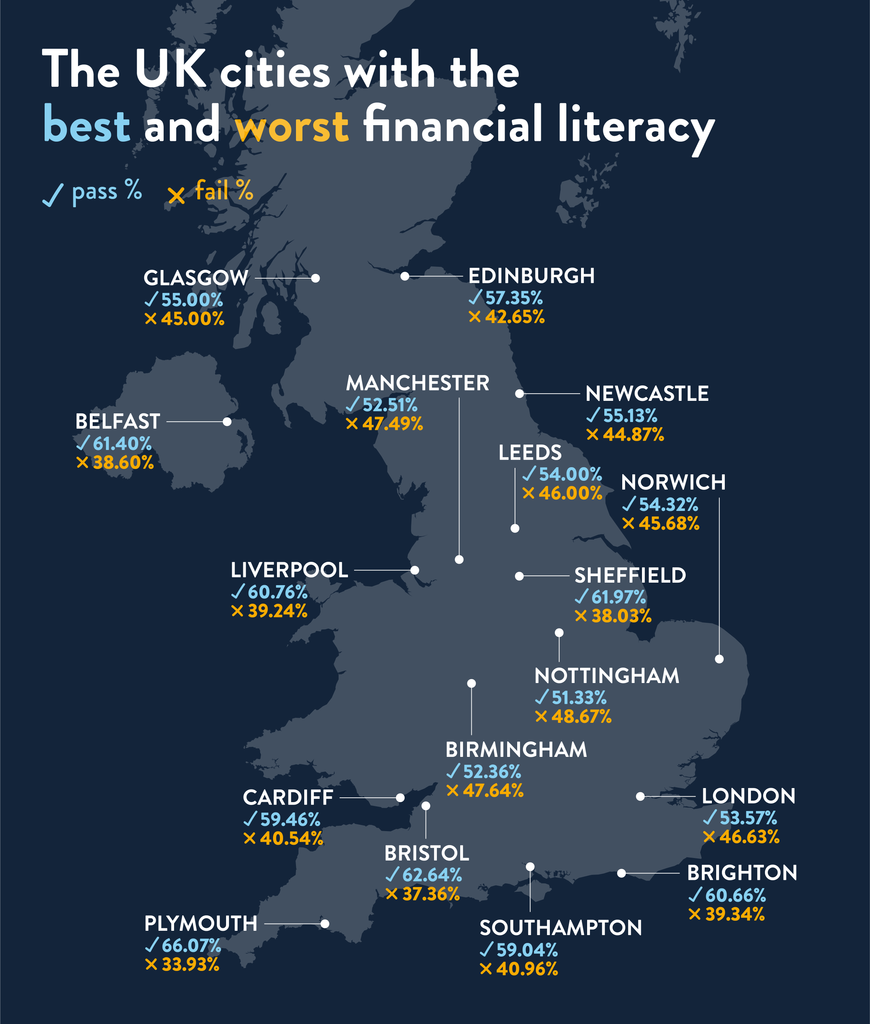
At the other end of the scale, Nottingham, Birmingham and Manchester recorded the lowest pass rates of 51%, 52% and 53% respectively. The gap between the highest and lowest-scoring cities was relatively small, though, suggesting financial literacy challenges are felt fairly evenly across the UK, rather than being concentrated in particular regions.
Our findings suggest Brits may know more about money topics than they think
The results reveal some interesting differences between what people know and how confident they feel. Across almost every topic tested, people scored higher on the quiz than their confidence levels suggested, underscoring how many people may be underestimating their understanding of money topics.
Investing shows the biggest gap between knowledge and confidence
Investment knowledge showed the most pronounced divide. While 61% answered the questions correctly, only 40% felt confident in their understanding, creating a 21% gap between confidence and knowledge.
This disconnect highlights that people’s approach to investing could be shaped by more than just what they know. Psychological factors, including their attitudes towards risk, confidence in their decisions and responses to uncertainty, can all influence how they approach investment opportunities.
For those considering investing for the longer term, a Stocks and Shares ISA offers a tax-efficient way to invest, with different investment options available to suit a range of financial goals and attitudes to risk. Understanding these options, alongside the potential risks and rewards, can help people make decisions that are appropriate for their individual circumstances.
ISAs show a similar gap, followed by mortgages and interest rates
ISAs showed a similar trend, with a 17% gap between confidence and knowledge. While the results indicate that many people have a stronger understanding of ISAs than they give themselves credit for, there is still a sizeable proportion who lack confidence when it comes to understanding how they work and the options available to them.
This uncertainty could have real financial implications. For example, someone who is unclear about the annual ISA allowance may not make full use of the tax-efficient benefits available to them, potentially missing out on tax-free interest or investment returns. Similarly, keeping savings in a current account that pays little or no interest, rather than considering whether an ISA account better suits their needs, could limit their potential returns and make it harder for their money to keep pace with inflation.
Understanding how ISAs work and the options available can help people make more informed decisions about where to hold their money, based on their individual circumstances and financial goals.
A similar pattern also appeared for interest rates and debt management, where knowledge outpaced self-assessed confidence by 11 and 6 percentage points, respectively.
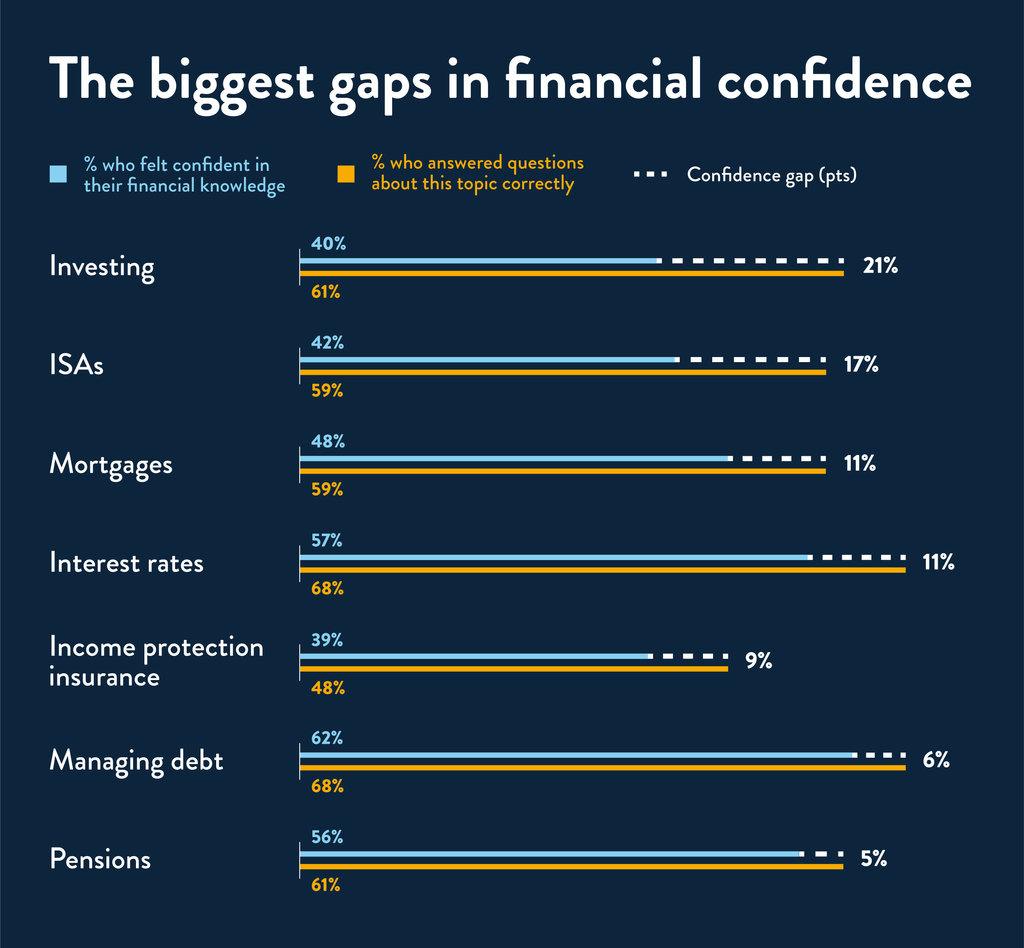
Income protection also stood out as an area where confidence lagged behind knowledge, with only 39% of people feeling confident about the topic despite 48% answering questions correctly. Income protection is designed to pay out a regular income if you’re unable to work due to illness or injury, helping to cover essential costs like your mortgage, rent or household bills. It can be especially valuable for anyone who doesn’t have sick pay to fall back on from an employer, such as those who are self-employed.
Derence Lee, Director of Finance and Investments at Shepherds Friendly, shares his insight into what the findings tell us about the relationship between financial knowledge and confidence.
“The results show that financial knowledge and financial confidence don’t always go hand in hand. In many areas, people answered more questions correctly than their confidence levels would suggest, which shows that some people may be underestimating what they actually know.
“When it comes to investing, for example, confidence can play an important role in how people approach it, but it is not always a reliable indicator of knowledge or ability. Those who are overconfident may underestimate the risks involved or make decisions without fully understanding the potential consequences, while those who lack confidence despite having a reasonable understanding of investing may feel reluctant to get started. For some, this uncertainty could mean keeping their money in cash for longer, where inflation may erode its purchasing power over time if interest earned does not keep pace with rising prices.
Clear explanations of products such as Stocks and Shares ISAs, alongside introductory education about investment options, risks and potential returns, can help people who feel less confident about investing better understand how these products work and make informed decisions based on their individual circumstances and financial goals.”
“Financial providers have an important role to play in making financial information clear, accessible and easier to understand, helping people better understand their options and make informed decisions. Individuals can also take steps to build their financial knowledge by learning about different financial topics, checking information from reliable sources and building understanding gradually. Together, these steps can help people feel more confident in their knowledge and better equipped to make informed decisions about their money.”
Older Brits know more than their confidence suggests
The biggest gap between knowledge and confidence was seen among those aged 55 and over. Just 32% of over-55s said they felt confident about investing, the lowest of any age group, yet they achieved the highest average correct-answer rate on the quiz at 67%, a 35% difference between the two measures. A similar pattern was seen across ISAs, interest rates and managing debt.
Interestingly, 25-34-year-olds showed the opposite pattern on some topics. When answering questions on topics including ISAs, pensions, managing debt and interest rates, their confidence levels were slightly higher than their quiz performance. These findings highlight that feeling confident about financial knowledge does not always reflect how well someone understands a topic.
One possible explanation for this is that younger adults may be familiar with financial terminology through social media and online discussions, so they may feel confident in their knowledge but have had fewer opportunities to actually apply this knowledge in practice. Meanwhile, older adults may have developed their understanding through years of managing their finances, even if they feel less confident in their knowledge.
Men are more confident in their financial knowledge, but not always more accurate
There were also notable differences between men and women. Men reported higher confidence than women across every topic we asked about, often by 15-20 percentage points. However, this was not always reflected in their quiz scores. For example, when it came to investing, men and women scored almost identically, with 62% and 60% answering questions on this topic correctly, respectively, despite a 20 percentage point difference in confidence (50% compared with 30%).
Research suggests that practical experience may help bridge this gender confidence gap. For example, a recent experiment found that participating in stock trading for four to seven weeks improved financial confidence among both men and women, with particularly strong effects among women. This suggests that confidence may not depend solely on financial knowledge, but can also develop through experience of making financial decisions.
These findings highlight that confidence and knowledge can tell different stories, and that feeling less confident does not necessarily mean someone has less knowledge of a particular financial topic.
Derence Lee, Director of Finance and Investments at Shepherds Friendly, adds:
“The differences we see across age and gender show that confidence can vary significantly between groups, but it doesn’t always tell us how much someone actually knows. In some cases, people performed well when tested despite having low confidence in their knowledge, while others felt more confident than their quiz results suggested.”
“For individuals, the takeaway is not to make assumptions about what you do or don’t know based on confidence alone. Taking the time to test your understanding, seek out reliable information and learn more about areas you’re less familiar with can help build a clearer picture of your financial knowledge and support more informed decision-making.”
200 years of helping people build a healthier financial future
Helping people build their financial understanding has been central to what Shepherds Friendly has stood for since 1826. Commenting on this year’s findings, Derence Lee, Director of Finance and Investments at Shepherds Friendly, says:
“For 200 years, Shepherds Friendly has been helping people plan for a more secure financial future. Over that time, we’ve seen that financial wellbeing isn’t simply about how much you earn or how much you know. It’s also about having the confidence to engage with your finances and understand the options available to you.
“This year’s Money Literacy Test highlights that there can be a difference between what people know and how confident they feel about that knowledge. As we celebrate our 200th year, we want to continue making financial information easier to understand and helping everyday people feel more comfortable engaging with their finances.
“If there’s one thing people can take from this research, it’s that financial knowledge doesn’t have to be something you have all figured out at once. Taking small steps, asking questions and using reliable, up-to-date information can all help people build their understanding over time. Whether that’s getting to grips with a topic they’re unfamiliar with or reviewing the options available to them, the important thing is to make decisions based on their own circumstances and take the time to understand what they’re choosing.
“That could mean reviewing your current finances, learning about different ways to save and invest, or simply asking questions about the areas you’re less familiar with. You don’t need to become a financial expert overnight; instead, think about turning knowledge you may already have into action, one step at a time.”
Methodology
We surveyed 2,001 Brits aged 18 and over on their knowledge of finance topics. The research was conducted between 28/08/2026 and 01/09/2026.
The pass rate of the quiz was calculated by finding the percentage of respondents who got 60% or more of the quiz questions on ISAs, investing, and general personal finance, including topics such as pensions and debt. In previous years, pass rates have been between 40% and 50%.
Please note that year-on-year comparisons of the Money Literacy Quiz pass rate have been made in this blog post (from 2023, 2024, 2025 and 2026), however, the quiz questions are not identical year-on-year. The aim is to measure overall financial literacy rather than exact question-level comparability.
To calculate the confidence gap, we took respondents’ self-reported confidence scores and compared them to the percentage of quiz questions respondents got correct in the quiz section of the survey.
When investing, your capital is at risk and you may get back less than you have put in. No advice has been given by Shepherds Friendly, and if you are in any doubt as to whether an investment or insurance plan is suited to your needs, then you should contact a financial adviser. There may be a charge for financial advice, and the cost should be confirmed to you before any advice is given.
The payout from an insurance policy may be less than what you have paid in. If premium payments are not kept up to date your policy may be cancelled. ISA tax rules depend on individual circumstances and may change in the future.